
Delaware Statutory Trusts (DSTs): A Beginner's Guide to Passive Real Estate Investing Through a 1031 Exchange
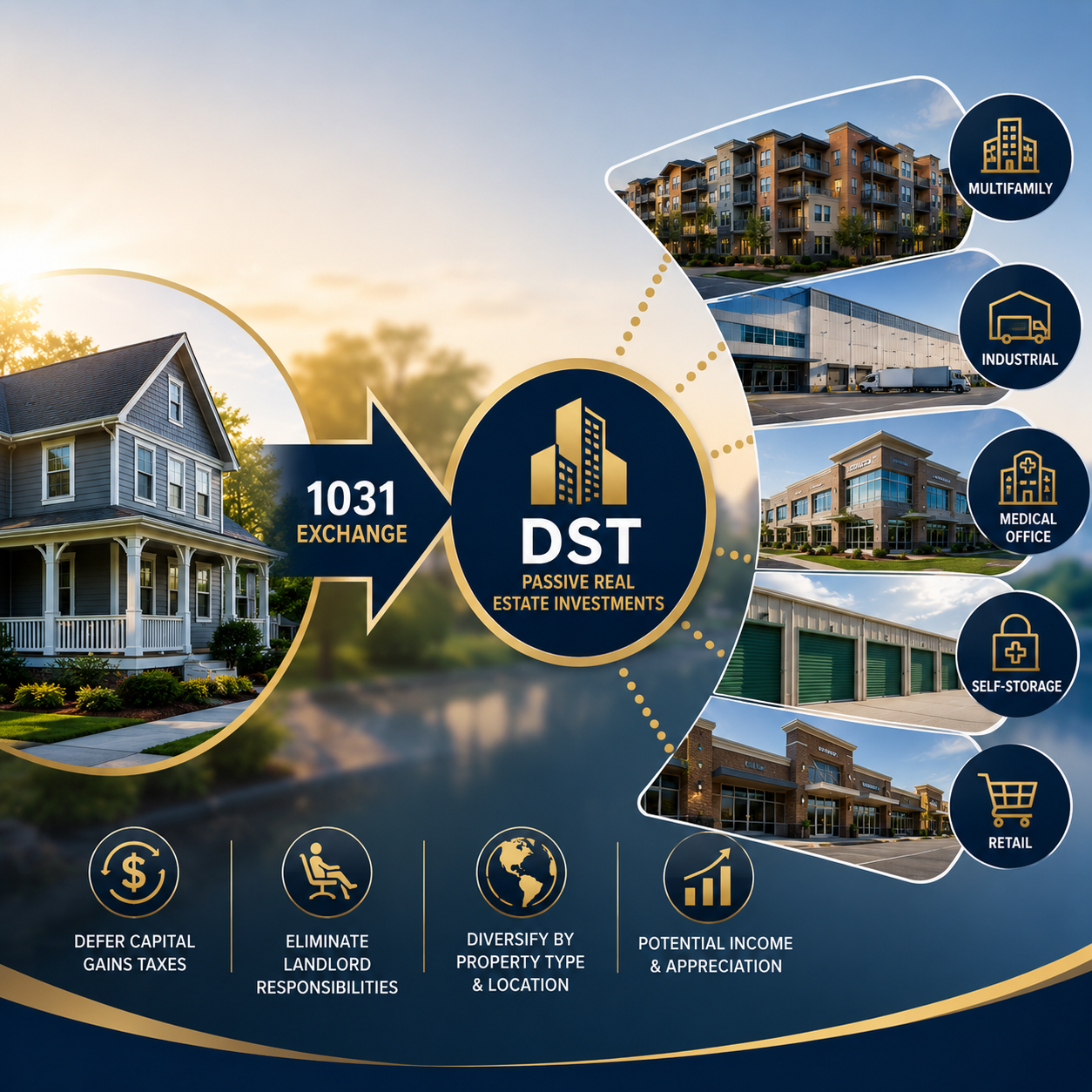
Many owners of rental property eventually reach the same point. They enjoy the value their real estate has created, but they no longer enjoy being a landlord.
Perhaps they are tired of late-night maintenance calls, difficult tenants, vacancies, repairs, insurance claims, or the ongoing responsibilities of managing investment property. Others simply want to retire, spend more time traveling, or make life easier for their children. Still others are approaching the sale of a highly appreciated investment property and are concerned about paying substantial federal and state capital gains taxes.
A Delaware Statutory Trust (DST) may provide a solution.
Although many investors have never heard of a Delaware Statutory Trust, DSTs have become an increasingly popular replacement property for investors completing a Section 1031 tax-deferred exchange. They allow qualifying investors to continue owning investment real estate in a much more passive manner while potentially deferring capital gains taxes.
This article explains what a Delaware Statutory Trust is, how it works with a 1031 exchange, its advantages and disadvantages, and whether it may be an appropriate option to discuss with your attorney, CPA, financial advisor, and qualified intermediary.
What Is a Delaware Statutory Trust?
A Delaware Statutory Trust, commonly called a DST, is a legal entity created under Delaware law that can own one or more investment properties.
Instead of purchasing an entire apartment building, office building, warehouse, medical office complex, or other commercial property yourself, you purchase a beneficial interest in the trust. The trust owns the real estate, while investors own fractional interests in the trust.
For federal tax purposes, properly structured Delaware Statutory Trusts generally qualify as ownership of real estate rather than ownership of a corporation or partnership. Because of this unique tax treatment, many DSTs qualify as replacement property for a Section 1031 exchange.
The IRS recognized this treatment in Revenue Ruling 2004-86, allowing properly structured DST interests to qualify as replacement property in many 1031 exchanges.
What Is a 1031 Exchange?
A Section 1031 exchange, often called a like-kind exchange, allows owners of investment or business real estate to sell one qualifying property and purchase another qualifying property without immediately recognizing federal capital gains tax or depreciation recapture.
Instead of paying taxes upon the sale, the taxes are generally deferred until a later taxable transaction occurs.
A properly structured 1031 exchange requires careful compliance with IRS rules, including:
- The replacement property must generally be identified within 45 days after selling the relinquished property.
- The replacement property generally must be acquired within 180 days after the sale.
- A qualified intermediary must generally be used to hold the sale proceeds.
- Numerous IRS requirements must be satisfied.
Because these deadlines are strict, experienced legal guidance is important.
How Does a Delaware Statutory Trust Work in a 1031 Exchange?
Instead of exchanging into another rental house, apartment building, or commercial property that you will personally own and manage, you may exchange into one or more Delaware Statutory Trusts.
Each DST owns institutional-quality real estate managed by professional asset managers.
Rather than collecting rent, negotiating leases, coordinating repairs, or responding to tenant issues, investors receive distributions if generated by the property's operations while professional managers oversee the day-to-day management.
This allows investors to continue owning investment real estate without continuing to be active landlords.
Why Are Delaware Statutory Trusts Becoming More Popular?
DSTs appeal to many investors because they solve a common problem.
An investor may have accumulated significant equity in rental real estate over decades, but no longer wishes to manage property. Selling outright could trigger substantial capital gains taxes and depreciation recapture.
A Delaware Statutory Trust may allow the investor to:
- Continue deferring taxes through a 1031 exchange.
- Eliminate most day-to-day management responsibilities.
- Continue owning real estate.
- Potentially receive regular income distributions.
- Continue participating in potential long-term appreciation.
Diversification Through Multiple Delaware Statutory Trusts
One of the greatest advantages of a Delaware Statutory Trust is diversification.
Suppose an investor sells a single apartment building in Vermont.
Rather than purchasing another single property, the exchange proceeds might be invested among several DSTs, such as:
- Multifamily apartments in Florida
- Medical office buildings in Texas
- Industrial distribution centers serving national tenants
- Self-storage facilities throughout the Southwest
- Grocery-anchored retail centers in the Midwest
- Manufactured housing communities
- Student housing
- Senior housing
- Hospitality properties
Instead of depending upon the success of one building in one market, the investor may own interests in numerous professionally managed properties located throughout the country.
Diversification does not eliminate investment risk, but it may reduce exposure to problems affecting any single property, tenant, or geographic market.
Access to Larger Investment Properties
Most individual investors cannot purchase a $75 million medical office building or a $150 million industrial distribution center on their own.
A Delaware Statutory Trust allows many investors to combine their capital to purchase larger institutional-quality real estate that may otherwise be unavailable to individual investors.
This type of "crowdfunding" provides access to professionally selected properties leased to national tenants in many cases.
Professional Management Replaces Active Landlord Responsibilities
Many investors eventually discover that owning rental property becomes increasingly demanding.
A DST replaces many landlord responsibilities with professional management.
Instead of dealing with:
- Tenant complaints
- Evictions
- Roof repairs
- Plumbing emergencies
- Leasing
- Property maintenance
- Employee supervision
- Insurance claims
professional property managers oversee daily operations.
This makes DSTs especially attractive for retirees, busy professionals, and investors who simply want a more passive investment.
Delaware Statutory Trusts May Be Particularly Attractive for Retirees
Many older investors have spent decades building wealth through rental real estate.
They may have no desire to completely exit real estate ownership, but they also no longer wish to actively manage properties.
A Delaware Statutory Trust allows them to remain invested in real estate while substantially reducing day-to-day responsibilities.
Many investors appreciate being able to travel, spend time with family, or enjoy retirement without worrying about emergency maintenance calls or tenant problems.
Estate Planning Benefits
For investors who do not need immediate access to the sale proceeds, a Delaware Statutory Trust can become part of a long-term estate planning strategy.
Under current federal tax law, some investors continue completing successive 1031 exchanges throughout their lifetime. This strategy is sometimes informally referred to as "swap until you drop."
If the investment is still owned at death, beneficiaries generally receive a stepped-up basis in inherited property under current federal tax law. This may substantially reduce or eliminate previously deferred capital gains taxes.
Tax laws can change, and every investor's circumstances differ. Investors should consult their estate planning attorney and tax advisor regarding their specific situation.
Moving Investments to Different Markets
Many investors accumulate properties close to home.
A Delaware Statutory Trust allows investors to exchange into properties located throughout the United States.
An investor selling Vermont investment property may ultimately own interests in properties located in numerous states and markets.
Depending on the investor's tax situation and residency, this may provide additional planning opportunities, although state tax consequences vary significantly and should be reviewed with a qualified tax advisor.
Delaware Statutory Trusts Can Serve as a Backup Replacement Property
One overlooked advantage involves the strict 45-day identification deadline.
Suppose an investor identifies an apartment building as the primary replacement property.
If that transaction falls apart after the identification period expires, the entire exchange could be jeopardized.
Many investors identify one or more Delaware Statutory Trusts as backup replacement properties during the identification period.
If the primary acquisition fails, the investor may still complete the exchange by acquiring one or more of the identified DST interests before the 180-day deadline.
Risks and Disadvantages of Delaware Statutory Trusts
Like every investment, Delaware Statutory Trusts involve risks.
Potential disadvantages include:
Limited Liquidity
DST investments are generally considered illiquid.
Investors should expect to hold their investment until the sponsor sells the underlying property. There is generally no established public market for selling beneficial interests.
No Management Control
Investors typically cannot make day-to-day management decisions.
Professional managers make operational decisions on behalf of the trust.
Investment Risk
Real estate values can decline.
Occupancy may decrease.
Economic conditions may affect rental income and property values.
Income and appreciation are never guaranteed.
Financing Risk
Changes in interest rates and financing conditions may affect investment performance.
Sponsor Risk
The quality and experience of the sponsor and management team are important considerations.
Investors should carefully review offering documents and conduct appropriate due diligence.
Tax Law Changes
Congress can amend tax laws.
Future changes could affect 1031 exchanges, depreciation rules, or estate tax planning opportunities.
Exit Strategies
Unlike personally owned rental property, investors generally cannot simply decide to sell whenever they choose.
Common exit strategies include:
- The sponsor sells the underlying property and distributes proceeds to investors.
- Investors receive cash upon liquidation.
- In many cases, investors may complete another properly structured 1031 exchange into other qualifying replacement property.
- Investors may continue holding their interests as part of a long-term estate plan.
Each investment offering may provide different exit opportunities.
Hypothetical Examples
Example 1: Retiring Landlord
A Vermont investor sells a 5-unit apartment building that has appreciated substantially over many years. Rather than buying another apartment complex, the investor completes a 1031 exchange into several Delaware Statutory Trusts holding multifamily housing, industrial warehouses, and medical office buildings. Professional managers take over daily operations while the investor remains invested in real estate.
Example 2: Backup Exchange Strategy
An investor contracts to purchase a shopping center as replacement property. Concerned the transaction might not close, the investor also identifies several Delaware Statutory Trusts during the 45-day identification period. When the shopping center purchase unexpectedly fails, the investor successfully completes the exchange using one of the previously identified DSTs.
Example 3: Estate Planning
A retired couple no longer wants to manage several rental properties but does not need the sale proceeds. They exchange into multiple Delaware Statutory Trusts, continue receiving income distributions as available, and incorporate the investments into their estate plan with the hope of obtaining a stepped-up basis for their heirs under current law.
Frequently Asked Questions
Can a Delaware Statutory Trust qualify for a 1031 exchange?
Many properly structured Delaware Statutory Trusts qualify as replacement property for Section 1031 exchanges.
Can I invest in more than one DST?
Yes. Many investors diversify by investing in several different Delaware Statutory Trusts.
Will I still be a landlord?
No. Professional managers generally handle the day-to-day operation of the properties.
Can I sell my investment whenever I want?
Generally not. DST investments are typically intended to be held until the sponsor sells the underlying property.
Are returns guaranteed?
No. Income, appreciation, occupancy, and property values are never guaranteed.
Does Peet Law Group recommend specific DST investments?
No. Peet Law Group does not recommend or sell Delaware Statutory Trust investments or provide investment advice. Investment decisions should be made with the assistance of your financial advisor and after reviewing the sponsor's offering materials.
How Peet Law Group Can Help
A Delaware Statutory Trust can be an excellent planning tool for the right investor, but it is not appropriate for everyone. Understanding the legal requirements of a 1031 exchange, meeting IRS deadlines, coordinating with a qualified intermediary, and reviewing contracts and closing documents require careful planning.
Peet Law Group represents clients throughout Vermont in connection with investment property sales and purchases, including the legal aspects of Section 1031 exchanges. We work closely with qualified intermediaries, CPAs, financial advisors, lenders, title companies, and DST sponsors to help facilitate successful transactions. While we do not recommend or sell Delaware Statutory Trust investments or provide investment advice, we can help clients understand the legal process, protect their interests during the exchange, and coordinate with the many professionals involved.
If you are considering selling investment property and would like to explore whether a Delaware Statutory Trust or another 1031 exchange strategy may fit your goals, contact Peet Law Group to discuss your options before your property is placed under contract. Early planning often provides the greatest flexibility and can help avoid costly mistakes.