
Is Your Vermont Home Haunted? What Sellers Must Tell Buyers
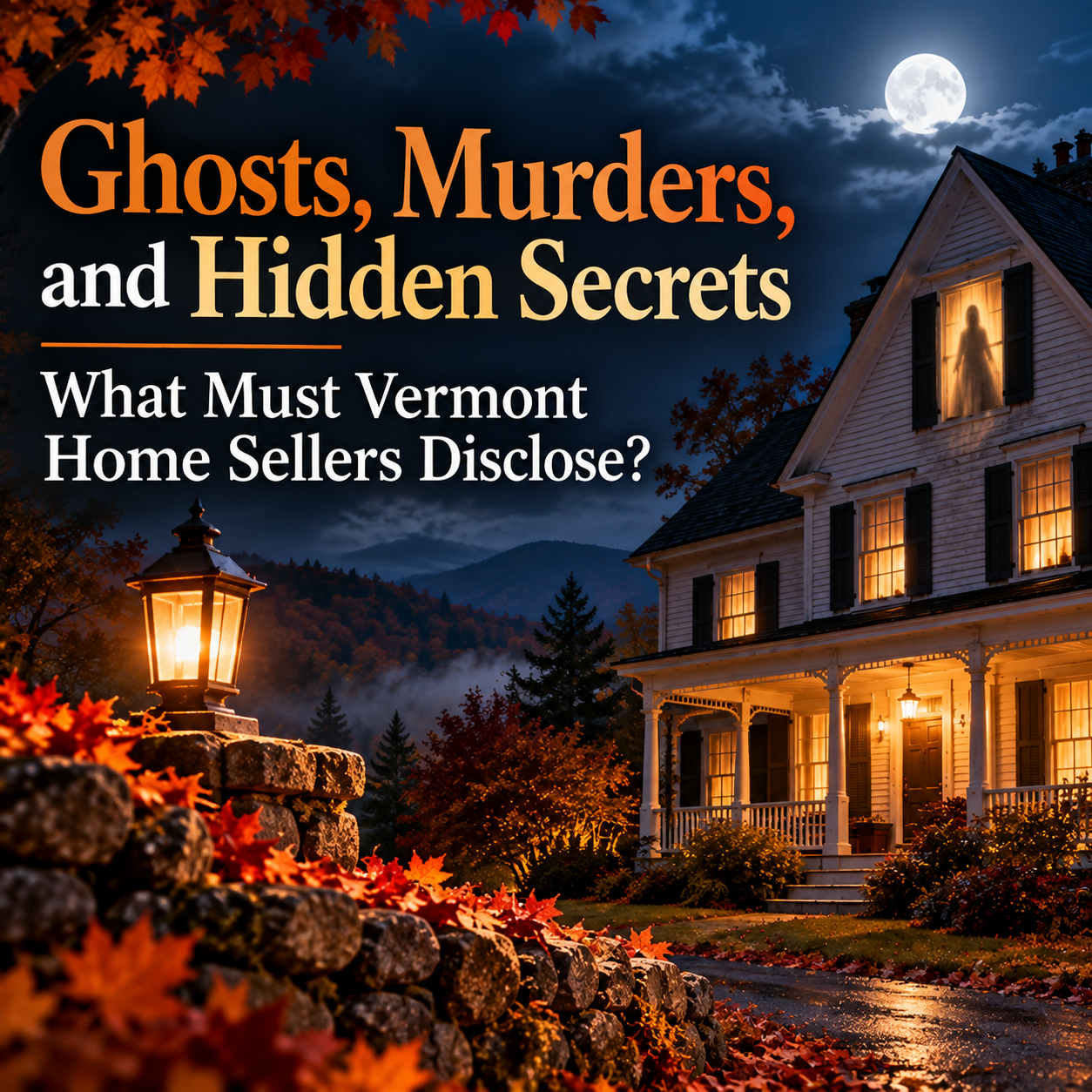
Imagine finding your dream home in Vermont. It has everything you want: beautiful hardwood floors, a cozy fireplace, mountain views, and perhaps even a charming covered porch.
There's just one problem. You hear footsteps upstairs when nobody is home. Doors seem to open by themselves. And a neighbor casually mentions that the previous owner may never have left.
Suddenly, you're wondering whether your dream home comes with an unexpected occupant.
Does Vermont law require a home seller to disclose that a house is haunted? What if someone died or was murdered there? And what about less supernatural surprises, such as a leaking basement or concealed structural problems?
The answers might surprise you.
Does Vermont Law Require Sellers to Disclose a Haunted House?
Generally, Vermont has no specific statute requiring home sellers to disclose that a property is allegedly haunted. We have also not identified a controlling Vermont Supreme Court decision establishing a general duty to disclose paranormal activity.
But that doesn't mean sellers can say anything they want about a property's history.
Vermont law recognizes potential liability for fraudulent misrepresentations and the concealment of certain material facts. Real estate agents also have statutory obligations to disclose material facts within their knowledge.
Whether a particular property's disturbing history must be disclosed can depend on the circumstances, including what the seller knows, what representations have been made, and whether the information materially affects the transaction.
And sometimes, buyers take matters into their own hands.
A Vermont Homebuyer Who Wanted a Ghost-Free Guarantee
Over the years, Peet Law Group has encountered some unusual requests while representing Vermont homebuyers and sellers.
One particularly memorable transaction involved a buyer purchasing a home in Richmond, Vermont.
The buyer was genuinely concerned that the property might be haunted. In fact, she was concerned enough to make her purchase contingent upon the house having "no ghosts or hauntings."
That's not a contingency you encounter every day in a Vermont real estate contract.
Most purchase agreements address matters such as financing, inspections, title examinations, and other customary considerations. This buyer wanted something a little more unusual: assurance that she wouldn't be sharing her new home with an unwelcome supernatural resident.
Fortunately, the buyer never raised an objection concerning ghosts or hauntings, and the transaction proceeded to closing in the ordinary course.
No paranormal investigation was necessary, and the unusual contingency did not prevent the sale.
The experience illustrates an important principle: Buyers and sellers can negotiate contractual provisions addressing concerns that matter to them, even when those concerns are not ordinarily covered by statutory disclosure requirements.
Of course, any unusual contingency should be carefully drafted so that both parties understand what it means and how it will be satisfied.
The Vermont House With a Basement Full of Sand
Ghosts aren't the only unusual things we've encountered in Vermont real estate transactions.
In another memorable case, a homeowner had filled the basement of her house with sand because of her personal superstitions. She did not want anything living beneath her.
And we aren't talking about a few bags of sand.
The basement had actually been filled with sand, and all of it had to be removed before the property could be sold to our client.
Unlike a rumored haunting, a basement filled with sand is a very real physical condition.
Whatever motivated the homeowner, the sand created a practical problem that needed to be addressed before the transaction could proceed.
This example illustrates the distinction between a property's reputation and its actual physical condition.
A buyer may be willing to overlook a ghost story. A basement filled with sand is considerably harder to ignore.
What If Someone Died or Was Murdered in a Vermont House?
A property can acquire an unsettling reputation without any suggestion of paranormal activity.
Perhaps a former occupant died in the home. Maybe a suicide occurred there decades earlier. Or perhaps the property was the scene of a notorious crime.
Real estate professionals sometimes refer to these as stigmatized properties, meaning properties whose histories or reputations may negatively influence buyers even though the events have not necessarily affected their physical condition.
Vermont does not have a specific statute generally requiring sellers to disclose every death, suicide, or homicide that occurred at a property.
However, sellers should not assume that every disturbing historical fact is legally irrelevant.
For example, a widely publicized crime might affect a property's marketability or value. Whether nondisclosure could create liability would depend on the particular facts and applicable legal principles.
The analysis can also differ depending on whether the seller is simply remaining silent or actively making representations about the property.
What If the Buyer Specifically Asks Whether Someone Died in the House?
Suppose a prospective buyer asks, "Has anyone ever died in this house?"
A seller who doesn't know the answer should not guess. And a seller who knows the property's history should not deliberately provide a false answer.
Vermont law recognizes claims based on fraudulent misrepresentation of material facts. Depending on the circumstances, misleading statements or partial disclosures may create legal exposure.
The safest approach is to provide accurate information about known facts and consult a Vermont real estate attorney when uncertain about disclosure obligations.
There's an important difference between saying, "I'm not aware of any deaths in the house," when that is true, and knowingly denying an event that actually occurred.
The same principle applies when buyers ask about alleged hauntings. A seller should distinguish personal experiences, rumors, and verifiable historical events rather than presenting speculation as fact.
Vermont's Famous Haunted Places
Vermont has no shortage of ghost stories. With its centuries-old buildings, historic inns, covered bridges, and rural cemeteries, the Green Mountain State provides plenty of settings for supernatural folklore.
Two well-known examples can be found in Stowe.
Emily's Bridge
The Gold Brook Covered Bridge, commonly called Emily's Bridge, is among Vermont's best-known allegedly haunted locations.
According to local legend, a young woman named Emily died near the bridge following a tragic romantic disappointment. Stories of strange noises, apparitions, and other unexplained occurrences have circulated for decades.
However, historical research has not substantiated the story of Emily's death at the bridge. The Vermont Historical Society has explained that the ghost legend appears to have developed during the late 1960s or early 1970s.
The bridge is real. The ghost story is part of Vermont folklore.
The Green Mountain Inn's Tap-Dancing Ghost
The historic Green Mountain Inn in Stowe has its own supernatural legend involving a former employee named Boots Berry.
According to the inn's account of the legend, Boots became known for tap dancing and later died after rescuing a child from the inn's roof during a snowstorm.
The story holds that his footsteps can still be heard tapping across the roof during stormy weather.
Whether those sounds come from a restless spirit, an old building, or something else is a matter of speculation.
Fortunately, Vermont real estate attorneys are generally called upon to investigate titles and contracts, not unexplained footsteps.
What Defects Must Vermont Home Sellers Disclose?
Although ghost stories may be entertaining, actual property defects present much more significant legal concerns.
Vermont does not impose a universal statutory requirement that every private home seller complete a comprehensive property-condition disclosure form covering every possible defect. However, specific disclosure requirements apply, and sellers can face liability for fraudulent statements or concealment of material information.
Can You Sell a Vermont House "As Is" Without Disclosing Problems?
An "as is" provision generally indicates that a buyer is accepting a property's condition subject to the terms of the agreement.
But selling a home "as is" does not automatically protect a seller from liability for fraud or eliminate statutory disclosure obligations.
For example, a seller who knowingly conceals a serious water problem or makes false statements about the condition of the property may still face legal consequences.
Likewise, an "as is" provision does not excuse compliance with Vermont's statutory flood disclosure requirements.
Buyers should understand that an "as is" purchase can involve substantial risks and should consider appropriate inspections and legal advice before signing an agreement.
Should Vermont Sellers Voluntarily Disclose a Haunted Reputation?
Even when disclosure may not be legally required, transparency can sometimes prevent misunderstandings and disputes.
Suppose a property has a widely known reputation for being haunted. Perhaps neighbors regularly tell ghost stories about the house, or the property has appeared in local media.
A seller may reasonably decide that addressing the reputation before closing is preferable to having an unhappy buyer discover it afterward.
That doesn't mean sellers should repeat unverified rumors as facts. Rather, they should consider the nature of the information, its reliability, and its potential significance to the transaction.
And if a buyer is particularly concerned about a property's history, those concerns should be raised before signing a purchase agreement.
After all, it's easier to negotiate a contingency before closing than to argue about a ghost afterward.
Don't Let Your Vermont Real Estate Transaction Become a Horror Story
At Peet Law Group, we've handled many unusual situations in Vermont real estate transactions, from a buyer concerned about ghosts to a basement filled with sand.
Most real estate surprises are far less entertaining. Title problems, undisclosed defects, contract disputes, and unexpected closing issues can turn an otherwise exciting purchase or sale into a stressful experience.
Our attorneys help Vermont buyers and sellers navigate purchase agreements, title examinations, real estate closings, and other legal issues associated with residential real estate transactions.
We can't promise your new home won't have a ghost. But we can help protect you from legal surprises that might keep you awake at night.
If you're buying or selling a home in Vermont, contact Peet Law Group, with offices in Williston and Hartford (White River Junction), to learn how our experienced Vermont real estate attorneys can assist you.
And if you hear mysterious footsteps in your new home, you might want to check the attic before calling your attorney.
Happy Halloween from Peet Law Group!